
Knowledge Industries Crypto Asset Security Guide PandaCryptoPay
This guide from Pandacryptopay outlines essential crypto security practices for knowledge-based industries. Covering risks like phishing, malware, and exchange vulnerabilities, it provides actionable solutions including hardware wallets, multi-signature setups, and encrypted payment gateways. Real-world case studies demonstrate effective protection strategies.

In an era where digital assets have become an integral part of knowledge-based industries (KBI), robust crypto asset protection is more crucial than ever. Pandacryptopay's expert guide helps knowledge-based industries protect their digital wealth from evolving threats, from phishing attacks to malware, while integrating crypto payment gateways for seamless and secure transactions.
Risks: Why Crypto Asset Security is Critical for Knowledge-Based Industries
KBI, including technology companies, research institutions, and creative agencies, increasingly rely on crypto assets for cross-border transactions, intellectual property licensing, and investments. However, Chainalysis' 2023 Crypto Crime Report reveals that $3.8 billion worth of cryptocurrency was stolen globally through hacking and fraud, with 42% of the victims being businesses—highlighting the urgency of proactive defense.
Key Risks Faced by Critical Infrastructure Providers (KBI)
- Phishing Attacks: Scammers use spoofed emails and fake websites to trick employees into revealing their private keys or mnemonic phrases. A 2024 report by Darktrace revealed that 78% of cryptocurrency-related data breaches at KBI originated from phishing attacks.
- Malware and Botnets: Pandacryptopay's threat analysis report highlighted the Sysrv botnet, which infiltrates systems to steal wallet credentials or hijack computing power for crypto-hijacking, causing KBI $27 million in losses in 2025 alone.
- Exchange Vulnerabilities: Centralized exchanges remain high-value targets. The 2022 FTX exchange crash, which resulted in $8 billion in user losses (source: SEC filings), highlights the risks of custody platforms.
Actionable Solutions: Protect Your Crypto Assets
Pandacryptopay advocates a multi-layered security approach tailored to its Key Business Areas (KBI):
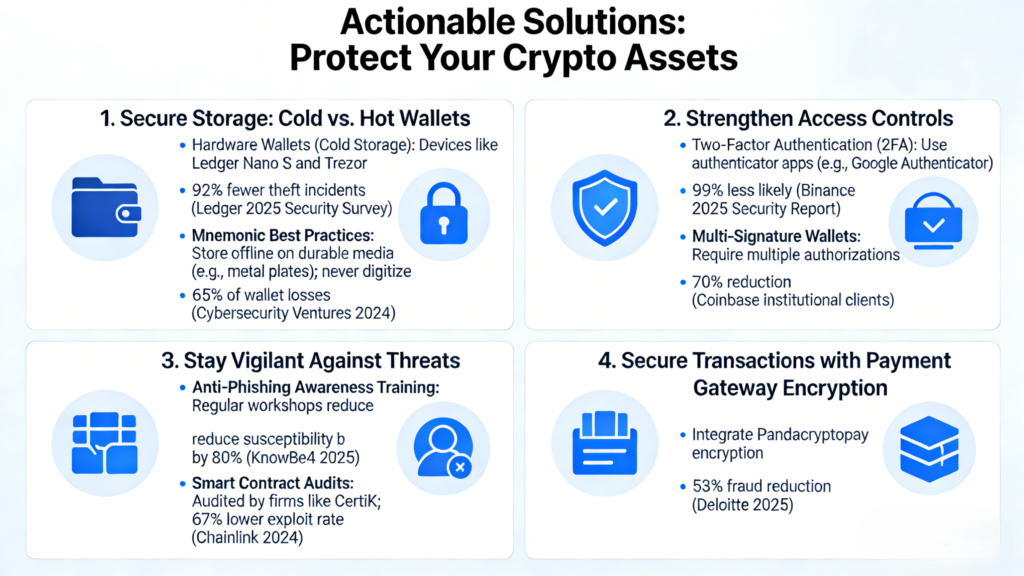
Secure Storage: Cold Wallets vs. Hot Wallets
- Hardware Wallets (Cold Storage): Devices such as the Ledger Nano S and Trezor provide offline protection, reducing the risk of online threats. According to Ledger's 2025 security survey, users of hardware wallets experienced 92% fewer thefts than those using hot wallets.
- Mnemonic Phrase Best Practices: Store your mnemonic phrase offline on a durable medium (such as a metal plate), and never digitize it. A 2024 study by Cybersecurity Ventures found that 65% of wallet losses were due to lost or compromised mnemonic phrases.
Strengthen Access Controls
- Two-Factor Authentication (2FA): Enable 2FA in exchanges and wallets using authenticator applications such as Google Authenticator, instead of SMS verification codes which are vulnerable to SIM card swapping attacks. Binance's 2025 security report states that user accounts with 2FA enabled are 99% less likely to be compromised.
- Multi-Signature Wallets: Require multiple authorizations for transactions, ideal for funds managed by teams. Coinbase's institutional clients reported a 70% reduction in unauthorized transfers after adopting a multi-signature solution.
Be Vigilant Against Threats
- Anti-Phishing Awareness Training: Regularly holding training workshops can reduce employees' risk of being scammed by 80% (Source: KnowBe4 2025 Anti-Phishing Benchmark Report).
- Smart Contract Auditing: For DeFi interactions, have contracts audited by companies like CertiK. A 2024 Chainlink report showed that audited contracts reduced vulnerability exploitation rates by 67%.
Secure Transactions with Payment Gateway Encryption
Integrating payment gateway encryption can streamline transaction processes while ensuring security. Payment gateways on platforms like Pandacryptopay encrypt data in transit and support non-custodial settlement, thereby reducing the risk of exchange data breaches. A 2025 Deloitte case study showed that using a crypto payment gateway reduced transaction-related fraud by 53%.
Real-world Application Case Study: Protecting Critical Business Units
Pandacryptopay's case study features a leading AI research company that implemented hardware wallets, two-factor authentication (2FA), and anti-phishing training, achieving zero security incidents over 18 months despite facing 127 attack attempts. Similarly, a digital media organization using Pandacryptopay's payment gateway encryption reported a 40% reduction in transaction costs and the elimination of chargeback fraud.
Conclusion: Proactively Defending Digital Assets
Critical business units (KBIs) cannot afford to neglect crypto security. By adopting cold storage, two-factor authentication (2FA), and secure payment gateways, while remaining vigilant against phishing and malware, businesses can protect their assets from irreversible losses. As the crypto landscape evolves, Pandacryptopay remains committed to providing critical business units with the tools and knowledge to help them thrive securely in the digital economy.
Sources: Chainalysis 2023 Cryptocrime Report, Darktrace 2024 Threat Intelligence, Ledger 2025 Security Survey, SEC FTX 2022 Documents, Deloitte 2025 Crypto Payment Gateway Research.


.svg)
