
Tokenized Cash Global Payments 2026 Historic Watershed
Stablecoins, based on blockchain technology—a new form of tokenized cash—are moving from fringe experiments to mainstream financial channels. Over the past three years, stablecoin trading volume has grown exponentially, beginning to pose a systemic challenge to traditional payment systems such as SWIFT and credit card networks.
Introduction: Structural Restructuring of the Payment System
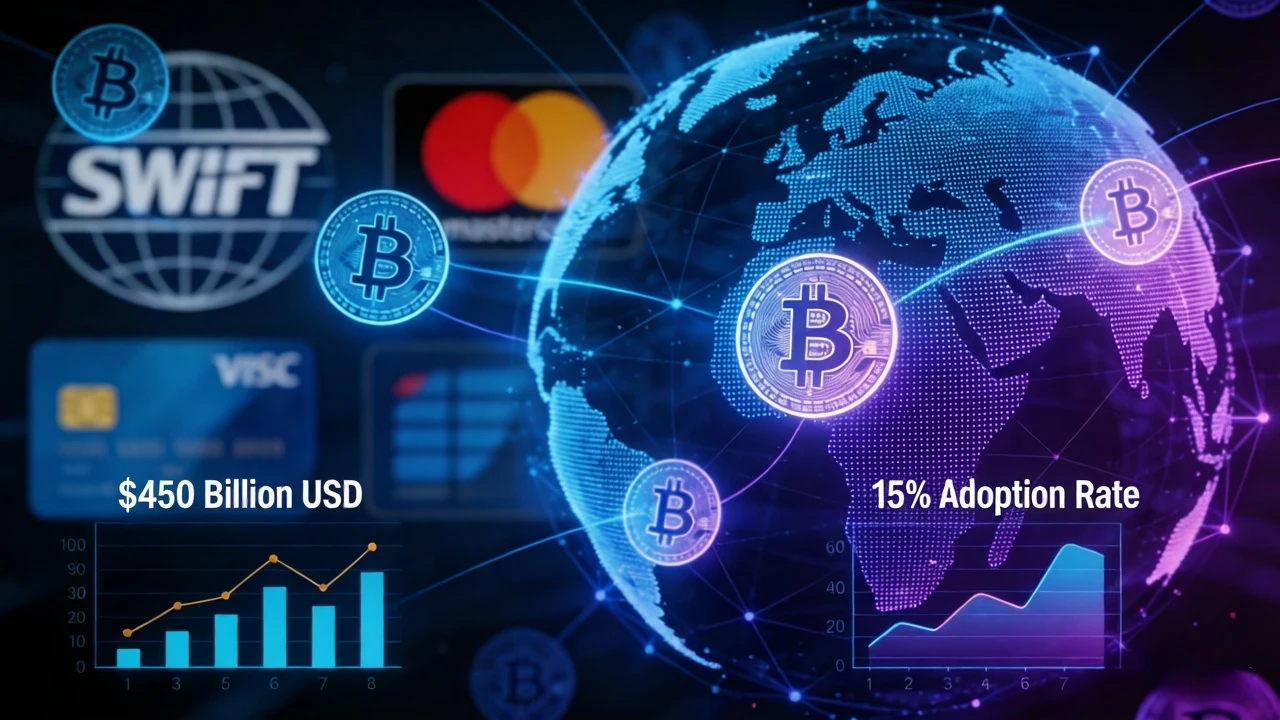
The latest data released by the Bank for International Settlements shows that the global daily settlement volume of digital stablecoins has climbed to $450 billion, with its penetration rate in cross-border capital flows soaring from less than 2% two years ago to 15%. This leapfrog growth signifies that digital stablecoins, relying on distributed ledger technology, have fully entered the core track of commercial finance from the "experimental field" of financial innovation, profoundly shaking the global payment ecosystem based on SWIFT and traditional credit card systems.
Over the past three to five years, the transaction volume of digital stablecoins has expanded exponentially. For financial institutions, capital providers, and policymakers, this is no longer a distant industry trend, but a strategic choice concerning survival – participants who actively embrace payment chain innovation will seize new growth curves, while those who adhere to traditional models will face a continuous decline in market share.
I. The Core Logic Behind the Rise of Digital Stablecoins
The essence of digital stablecoins is to anchor the value of fiat currency to programmable and divisible digital certificates through a distributed network, achieving "on-chain circulation of fiat currency." Compared to traditional payment models, their core competitiveness lies in four dimensions: extreme efficiency, cost advantage, compliance and transparency, and functional scalability.
In terms of timeliness, the real-time clearing and settlement mechanism of decentralized ledgers compresses international remittances from 2-3 business days to seconds. A Q1 2025 report by blockchain research firm Messari shows that the median final confirmation time for transactions on high-performance public chains such as Solana and Avalanche is consistently within 2 seconds, reaching as low as 400 milliseconds in optimal scenarios. In terms of cost, on-chain transfer fees are only less than 2% of traditional cross-border remittances, reducing the original 5%-7% overall fee rate to near zero. In terms of compliance, the entire on-chain fund flow is traceable, improving the efficiency of anti-fraud and compliance reviews by over 50%. Furthermore, the embedding of smart contracts automates complex scenarios such as conditional payments and multi-party revenue sharing, providing new solutions for supply chain finance and other fields.
Market data confirms its commercial value: the daily settlement volume of mainstream USD reserve stablecoins on a single chain has exceeded $100 billion, surpassing some traditional real-time payment systems. McKinsey's 2025 report, "The Rise of Digital Currencies," and Bloomberg's concurrent industry research forecast both predict that the global stablecoin market capitalization is expected to reach $2.5 trillion by 2028, demonstrating strong growth momentum.
II. Traditional Payment Bottlenecks and Stablecoin Breakthroughs
The structural defects of traditional cross-border payment systems are becoming increasingly prominent. Taking Volkswagen Group's 2024 supply chain finance case as an example, when paying a Mexican parts supplier, the payment involved multiple layers of intermediaries—the opening bank, two agent banks, and the receiving bank—resulting in a 6.8% fee and exchange rate loss, with funds taking up to 3.5 business days to arrive. Ordinary consumers incur 2%-3% currency conversion fees for overseas credit card spending, while the payment cost of compliant stablecoins is less than one percent of traditional methods.
Digital stablecoins have achieved substantial breakthroughs in multiple scenarios: JPMorgan Chase's JPM Coin system, developed based on a private blockchain, maintains a stable daily transaction volume of $30-35 billion, providing multinational corporate clients with 24/7 real-time cross-border capital transfers, reducing the amount of funds tied up in transit by approximately 30%; expatriate workers in South Asia have reduced the overall cost of transferring funds back home using stablecoins from 6%-8% to negligible levels, and shortened the arrival time from several days to minutes; a digital payment system of a Middle Eastern energy company has reduced settlement costs for hundreds of its branches by 35% and increased transaction efficiency several times over.
III. Three Driving Forces for 2026 as a Turning Point:
The formation of a regulatory framework is the primary driving force. The EU's Crypto Asset Market Regulation (MiCA) has been fully implemented, clarifying the reserve asset requirements, information disclosure, and compliance obligations of stablecoin issuers. Key progress has been made in the US draft legislation, establishing regulations across dimensions such as market access, custody, and liquidity management. More than 30 countries, including the UK, Singapore, and Japan, have also introduced or are accelerating the development of targeted regulatory systems, clearly defining the boundaries for industry development.
Mature underlying technologies lay the foundation for large-scale deployment. Privacy-enhancing technologies such as zero-knowledge proofs have achieved commercial deployment, protecting transaction privacy while meeting regulatory audit requirements. The security of cross-chain interoperability protocols has significantly improved, with asset losses due to security incidents decreasing by over 80% year-on-year. Enterprise-level digital asset custody solutions integrate multi-party secure computation and hardware isolation technologies, significantly reducing private key management risks.
Market demand is accelerating ecosystem development. Several top asset management companies have launched blockchain fund products, using stablecoins for subscription and redemption settlements. Cross-border payment pilot programs jointly promoted by central banks in multiple countries have entered the trial operation phase, exploring interoperability mechanisms between central bank digital currencies and stablecoins. The number of active digital wallet users worldwide has exceeded one billion, with more than half having used stablecoins for payments or transfers.
IV. Strategic Action Guidelines for Multiple Entities
Commercial Banks and Payment Institutions: Adopt a gradual approach – short-term focus on accessing compliant third-party stablecoin payment channels; medium-term plan to issue tokenized liability certificates linked to deposits; long-term participation in the construction of next-generation clearing and settlement infrastructure. Prioritize pilot programs in scenarios such as cross-border e-commerce, commodity trading, and cross-border payroll, accumulating experience through industry collaboration.
Investment Institutions: Focus on sectors such as digital payment interface service providers, licensed stablecoin issuers, and central bank digital currency system service providers. Prioritize issuers with reserves in highly liquid sovereign bonds and cash-like assets, and exercise caution with algorithmic stablecoins lacking sufficient collateral. It is recommended to allocate 5%-10% of the investment portfolio to the digital payment infrastructure sector, balancing risk and return through multi-stage project portfolios.
Regulators: Build an inclusive and prudent governance environment – establish “regulatory experimental zones” to allow innovative business testing; require stablecoin issuers to disclose the composition of their reserve assets daily; promote international cooperation on cross-border liquidity relief mechanisms; clarify the legal rights of holders, and establish a user compensation fund.
For ordinary users: Acquire mainstream stablecoins through regulated platforms, store large amounts of digital assets offline using hardware wallets, and enhance security through multi-signature verification.
Conclusion: A Historic Evolution of Payment Paradigms
2026 will be a watershed year for the global payment landscape. Digital stablecoins are evolving from alternatives to traditional payments into core settlement infrastructure for the digital economy. Just as the internet reshaped information transmission, stablecoins are reshaping the underlying logic of value transfer—shifting from a trust model backed by centralized institutions to a digital trust mechanism based on algorithms and public rules.
According to professional predictions, the global circulating market capitalization of stablecoins may approach $2.5 trillion by 2028, with daily transaction volume potentially surpassing that of existing mainstream bank card networks. The depth and breadth of this transformation will exceed expectations. Financial institutions need to redefine their roles in payment services and value exchange, and policymakers need to seek a dynamic balance between innovation and stability. For all participants, the key is no longer "whether to participate," but "how to establish a core position in this irreversible transformation" and jointly embrace the historic evolution of financial payments.



.svg)
